
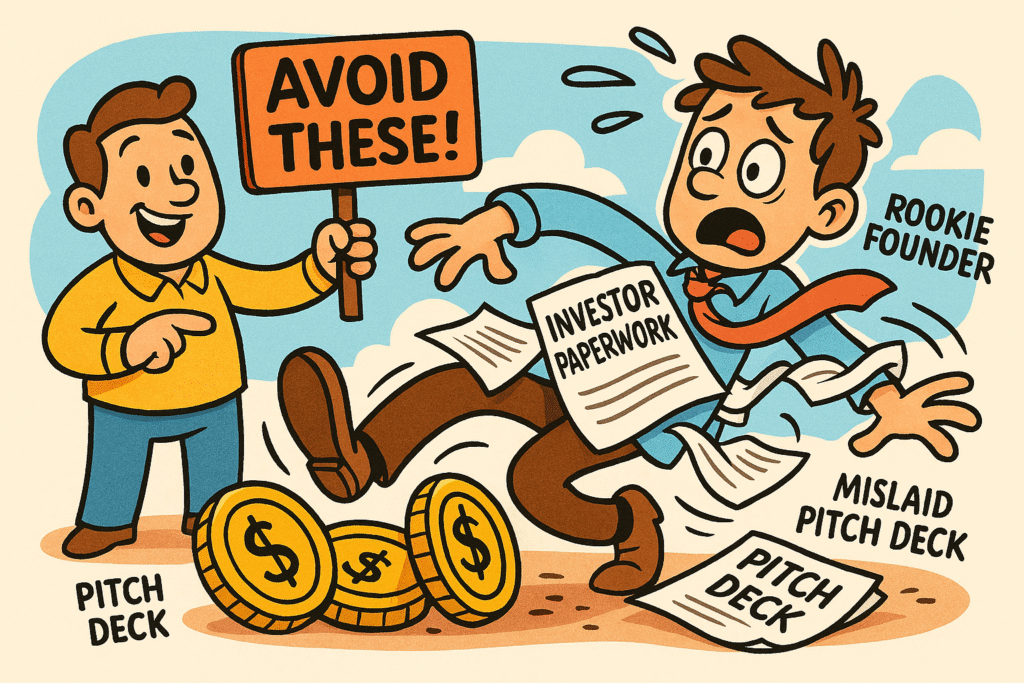
Raising capital is hard enough without shooting yourself in the foot. Yet first-time founders repeatedly make the same startup funding mistakes that cost them investors, credibility, and sometimes their entire company.
Mistake 1: Waiting Too Long to Start Fundraising
Most founders have no idea it takes 6-9 months from the first pitch to the closed deal.
Want polished, research-backed blog content that keeps readers hooked? ➜ Tap here to hire professional writers and get started today.
By the time you desperately need money, it’s too late. Investors can smell desperation from miles away, and it kills your negotiating power.
It Pays to Start Relationships Early
The best funding relationships begin 12-18 months before you actually need the cash.
Attend industry events. Share your progress. Build genuine connections with potential investors without asking for anything. When you’re ready to raise, you’ll have warm introductions instead of cold emails that never get opened.
This approach works across industries-be it revolutionizing business trends by providing AI solutions or disrupting conventional markets with fresh approaches.
Mistake 2: Pitching Without Product-Market Fit
You’ve built something. That doesn’t mean that anybody wants to buy it.
One of the most common startup funding mistakes is seeking investment before proving customers will actually pay for your solution. Investors want traction, not theory.
Show Real Revenue or Engagement
Get customers: 10 paying users or 1,000 active users, whatever may be the case.
Real data trumps beautiful projections every time. If you can’t get customers to use your product for free, much less at a discount, why would investors think you’ll be able to sell it at scale?
Mistake 3: Asking for an Inadequate Amount
You’re either asking for too little and signaling you don’t understand your business, or you’re asking for too much and you price yourself out of the realistic conversations.
Most founders choose a number that “sounds right” without doing the actual math.
Calculate Your True Runway Requirements
Work backward from your 18-24 month milestones.
How much is product development going to cost? What is your team burn rate? How about marketing spend to hit your growth targets? Add 30% buffer for the unexpected expenses that always materialize.
How it works is: Monthly burn rate × 18 months × 1.3 (buffer) = minimum raise amount. If you’re burning $50K/month, that’s $50K × 18 × 1.3 = $1.17M minimum.
This financial planning echoes the discipline needed to handle personal finance-you need to account for every single dollar’s destination.
Mistake 4: Not addressing cap table management from day one.
If you don’t manage your cap table properly from the start, it will be a time bomb.
Giving away too much equity too early on is one of those fatal startup funding mistakes. By the time you reach Series A, you might own less than 30% of your own company.
Reserve Equity for Future Rounds
Plan your equity distribution across several funding rounds.
- Founders should aim to keep 15-25% post-Series B
- Allocate 10-20% for employee stock options.
- Understand dilution at every stage of the round and negotiate anti-dilution protection.
Don’t give your college roommate 25% equity for building your MVP. Pay contractors when possible, or much smaller equity stakes with vesting schedules are far better.
Mistake 5: Not performing due diligence on investors
You wouldn’t marry someone after one date, so why take money from investors you barely know?
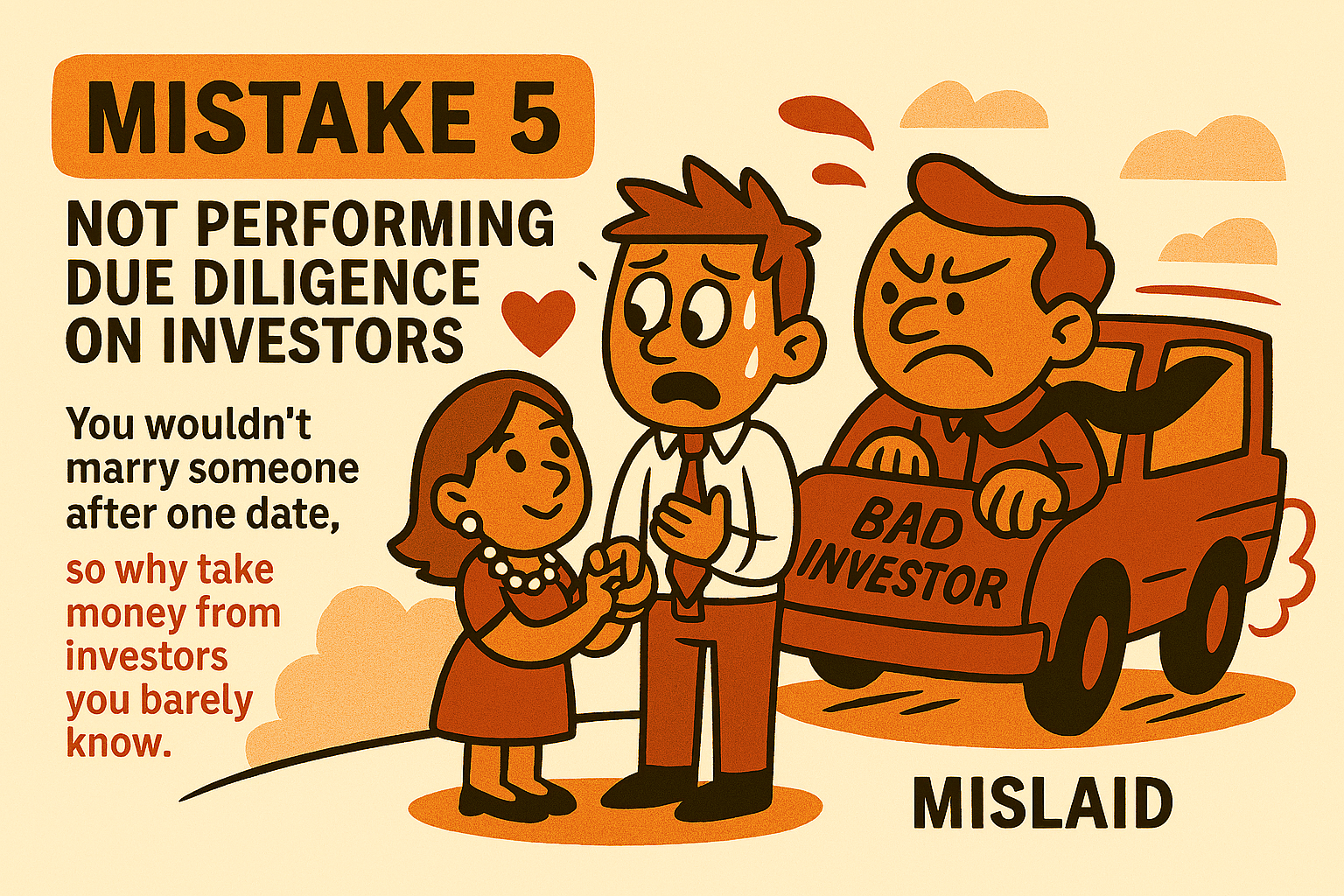
Bad investors are worse than no investors. They’re going to miss follow-on rounds, force terrible pivots, or inject board drama into your company culture and destroy it.
Do Your Homework on Potential Partners
Speak with other founders in their portfolio-particularly those whose companies have failed.
Check how active they are post-investment. Do they actually provide the value-add that they’ve promised, or do they disappear until the next board meeting? Understanding the landscape is as crucial as staying current with tech trends that could affect your industry.
Mistake 6: Having unrealistic financial projections
Your hockey stick growth chart isn’t impressing anyone.
Experienced investors have seen thousands of projections. They know when you’re fabricating numbers to make your deal look attractive.
Create Bottom-Up Projections Based on Reality
Start with the known and the provable.
If you have 100 customers today and 20% monthly growth, show how you’ll get to 500 customers in six months through specific, funded marketing channels. Don’t say that you’ll magically jump from $50K to $5M ARR because the “market is huge.”
Mistake 7: Spending All Your Time on Valuation
Getting a high valuation feels like winning, but it often sets you up to fail.
When you raise at an inflated valuation, your next round becomes all but impossible. You have to demonstrate enormous growth to justify an up-round, or face the music with a down-round that saps morale and creates retention nightmares.
Optimize for Terms – Not Just Price
Liquidation preferences matter more than headline valuation, as do board composition and investor rights.
A $10M valuation with awful terms is worse than an $8M valuation with founder-friendly provisions. Get a lawyer who specializes in startup funding to review every term sheet.
Quick check of valuation: Post-money valuation = investment amount ÷ percentage of company sold. If an investor offers $2M for 20%, your post-money valuation is $10M ($2M ÷ 0.20). Your pre-money valuation is $8M ($10M – $2M).
Mistake 8: The wrong investors being pitched to
Not all money is good money, and not all investors are right for your stage.
Approaching a Series B fund for seed capital is a waste of everybody’s time. Each one of these startup funding mistakes compounds: wrong investors, wrong timing, wrong ask.
Target appropriate investors at the stage
Research funding theses and check requirements before reaching out.
- Friends & Family/Bootstrapping: <$100K rounds, Personal Networks and Savings
- Pre-seed/Seed: $100K-$2M rounds, often angel investors or micro-VCs
- Series A: $2M – $15M rounds, early-stage VCs
- Series B: $15M+ rounds, growth-stage funds
Also consider industry focus: A healthtech fund will never invest in your fintech startup, no matter how good your pitch may be.
Mistake 9: Not taking your story seriously enough
Investors hear 50 pitches a week. Most blur together in a forgettable mess of market sizes and competitive advantages.
It’s your story that makes you memorable.
Create a compelling narrative
Why does your company need to exist? What personal experience drove you to solve this problem?
Connect emotionally before you drown investors in metrics. The best pitches feel like origin stories: here’s the villain-the problem-your hero’s journey-your solution-and the stakes that matter-why now, why you.
Real-world example:
“After watching my mother ration her insulin because she couldn’t afford both rent and medication, I spent three years building a platform that cuts prescription costs by 60% through direct partnerships with pharmacies-and we have already helped 12,000 families afford the treatments that keep them alive.” – That’s a story investors remember!
It is a storytelling principle that applies whether one is in pop culture entertainment, health and fitness wellness products, and anywhere in-between.
Making Complex Ideas Accessible
If your grandmother can’t understand what you do, simplify it!
Complexity doesn’t equal sophistication. The best founders can explain their business model in one sentence that a 12-year-old would grasp.
Mistake 10: Going It Alone Without Advisors or Mentors
First-time founders often think that asking for help is a sign of weakness.
What investors actually want to know is that you are coachable and smart enough to take advantage of experienced guidance. Without mentorship, avoiding startup funding mistakes is rather like hiking Everest without a sherpa.
Advisory Board – Build It Before You Need It
Identify 3-5 advisors who have successfully raised capital in your industry.
Offer small equity stakes (0.25-1%) in exchange for monthly calls and introductions. The right advisor opens doors that cold outreach never will.
Look for advisors across different domains—someone who understands your market, someone who’s raised multiple rounds, someone with operational expertise. This diverse perspective helps whether you’re navigating travel and tourism hospitality tech, green tech and living sustainability solutions, or home improvement and real estate proptech innovations.
Awareness is the first step forward.
Every successful founder has made startup funding mistakes—the difference is learning from them quickly.
The ones who succeed don’t repeat the same errors round after round. They adapt, they listen, and they build relationships based on mutual respect rather than desperation.
Your funding journey doesn’t have to be a series of expensive lessons learned the hard way. With the right strategy, preparation, and positioning, you can avoid these common pitfalls and present your startup as the compelling investment opportunity it truly is.
Ready to Tell Your Startup’s Story to the Right Investors?
Getting in front of investors is only half the battle—you need the right narrative, positioning, and media presence to stand out in a crowded market.
Press N’ Release Agency specializes in helping startups craft compelling stories that attract investor attention and media coverage. Our strategic PR packages ensure your funding announcements, milestone achievements, and thought leadership content reach the audiences that matter most.
From press release distribution to ongoing content marketing that builds your brand authority, we help founders avoid another critical mistake: raising capital in silence.
Explore our tailored packages at Press N’ Release Agency and discover how strategic storytelling can transform your fundraising outcomes. Your next round starts with the right message—let’s craft it together.