

Climate action is not only good ethics, it’s good business. Companies with reduced business carbon footprint operations see lower costs, stronger brand loyalty, and better positioning for future regulations.
Why Reducing Your Carbon Footprint Matters Now
The business case for sustainability has never been clearer. Consumers are increasingly choosing brands that reflect their values, with 73% happy to pay more for sustainable products. Investors are focusing on ESG metrics, and governments across the world are setting ever-tightening emissions standards.
Want polished, research-backed blog content that keeps readers hooked? ➜ Tap here to hire professional writers and get started today.
But here’s the good news: most carbon reduction strategies also cut operational costs.
№ 1 — Conduct a Carbon Audit First
You can’t manage what you don’t measure. Begin with a thorough carbon audit to understand the biggest sources of your emissions, such as energy consumption, transportation, and supply chain operations.
Tools such as the EPA’s Carbon Footprint Calculator, or companies like Watershed and Persefoni, make this relatively easy. Most companies also find that 80% of their emissions are created by 20% of their operations.
Once you know where you stand, focus on implementing high-impact, low-cost changes first.
№ 2 — Switch to Renewable Energy Sources
Energy use often represents the single largest controllable emission source. Transitioning to renewable energy yields both immediate carbon reductions and long-term cost savings.
Solar panels: The most accessible entry point for most businesses, commercial installations usually pay for themselves within 5-7 years through energy savings and tax incentives. If that’s not possible, consider community solar programs or renewable energy certificates.
Many utility companies are now offering green energy plans that get their electricity from wind, solar, or hydroelectric power. The price premium has shrunk dramatically, with some even costing the same as conventional power.
№ 3 — Optimize Your Building’s Energy Efficiency
Simple efficiency upgrades frequently yield the quickest ROI. LED lighting utilizes 75% less energy than incandescent bulbs and lasts 25 times longer. Smart thermostats, such as Nest or Ecobee, learn usage patterns and adjust automatically to reduce heating-and-cooling costs by 10-20%.
Proper insulation matters more than most business owners appreciate. Air leaks around windows, doors, and ductwork waste substantial energy. Professional energy audits—often subsidized by utility companies—identify these opportunities.
For instance, Microsoft managed to cut 10% of energy use in its facilities by simply optimizing the HVAC systems and deploying better building management software.
№ 4 — Embrace Remote and Hybrid Work Models
A large portion of emissions in business also comes from transportation. Remote work entirely eliminates the need to commute while offering better work-life balance for employees.
Hybrid models allow flexibility while retaining office culture. Other companies, such as Salesforce and Twitter (X), have made flexible work permanent, reducing their real estate footprint and associated emissions.
Even just two remote days per week per employee can reduce business carbon footprint by thousands of tons annually for medium-sized companies.
№ 5 — Rethink Business Travel Practices
Aviation yields enormous carbon emissions-a single round-trip flight from New York to London generates nearly 1 ton of CO2 per passenger. Video conferencing technology has matured dramatically, and for most purposes, virtual meetings are genuinely effective.
When travel is necessary, prefer direct flights (which produce the most emissions during takeoff and landing), economy class (far more efficient per passenger), and carbon offset programs. Companies like Stripe and Shopify have implemented an internal carbon tax on employee travel, which incentivizes thoughtful trip planning.
Ground transportation also presents possibilities for optimization. Electric car fleets, public transit subsidies, and even bike-sharing programs all cut emissions while often increasing employee satisfaction.
№ 6 — Supply Chain Transformation
Supply chain emissions—commonly referred to as Scope 3 emissions—can dwarf direct operational emissions. Engaging suppliers on sustainability creates ripple effects across your industry.
First, request carbon footprint data from major suppliers. Many will embrace the conversation because they too are receiving similar requests from their customers. Seek out local suppliers to help lower transportation emissions and strengthen regional economies.
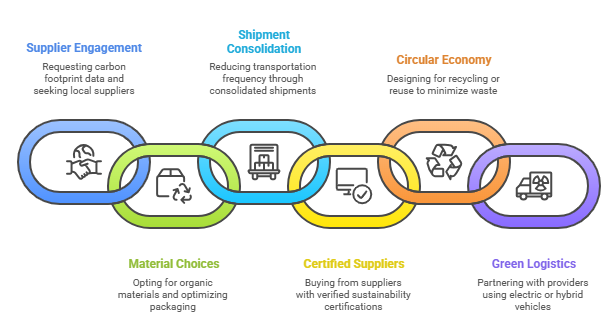
Material choices matter enormously. Patagonia famously switched to organic cotton despite higher costs, reducing its environmental impact while strengthening brand identity. Optimizing packaging-smaller boxes, recycled materials, reduced plastic-offers quick wins.
Consider the following proven strategies:
- Consolidate shipments to reduce frequency of transportation
- Buy from suppliers whose sustainability certifications have been verified.
- Implement the circular economy principles – design for recycling or reuse
- Partner with logistics providers using electric or hybrid vehicles
№ 7 — Reduce, Reuse, Recycle: In That Order
Waste reduction begins with consumption. Does your office really need single-use items? Switching to reusable dishware, eliminating disposable coffee pods, and providing filtered water instead of bottled water seem like small items, but they add up incredibly.
Composting programs divert organic waste from landfills, where it produces methane-a greenhouse gas 25 times more potent than CO2. Increasingly, cities are offering commercial composting services, with the resulting compost supporting landscaping needs.
Digital documentation reduces paper consumption. Companies like Dropbox and DocuSign built whole business models on that concept, and now it’s within the reach of every business.
№ 8 — Invest in Carbon Offset Programs
While reductions in direct emissions should be priority number one, carbon offsets address emissions that can’t be avoided. Quality matters enormously here: not all offset programs deliver real climate benefits.
Look for projects independently certified by Gold Standard 🟡 or Verified Carbon Standard 🟢. Effective categories of offsets include reforestation, renewable energy development in emerging markets, and methane capture from landfills.
Stripe’s Frontier program is a prime example of innovative offset investing, funding emerging carbon removal technologies. Similar initiatives have become accessible for even the smallest businesses via platforms like Wren or Cloverly.
Remember: offsets complement reduction efforts, they don’t replace them.
№ 9 — Engage Employees in Sustainability Efforts
Your team represents your biggest resource in the identification of efficiency opportunities. Many employees working with systems on a daily basis identify waste that leadership may overlook.
Establish a green team of volunteers enthusiastic about sustainability to champion the initiatives and maintain the momentum. Salesforce’s “Earthforce” volunteer network is thousands strong, driving sustainability projects at the company globally.
Recognition programs incentivize participation. Microsoft’s annual Hackathon includes sustainability challenges, which has generated innovative solutions while building the culture. Simple idea submission systems with small rewards also work very well.
Education amplifies impact. Climate change lunch-and-learn sessions, workshops on sustainability, and transparently sharing company progress all serve to keep everyone aligned and motivated.
№ 10 — Leverage Technology for Smarter Operations
Modern technologies allow efficiency never seen before. IoT sensors track energy consumption in real time and automatically detect waste. AI-powered systems optimize everything, from lighting to inventory management.
Cloud computing reduces the need for energy-intensive on-premise servers. Companies like Google and Amazon run data centers at far greater efficiency than individual businesses can, and they’re increasingly powered by renewable energy.
Blockchain technology is developing in support of supply chain transparency to independently verify sustainability-related claims across complex networks. Still in development, these will be an increasingly important tool.
» The ROI of Reducing Your Carbon Footprint
The financial case continues to strengthen: Energy efficiency improvements typically deliver cost reductions of 20-30%. Employee retention improves, particularly among younger workers who place a premium on purpose-driven employers. Brand value rises as sustainability becomes a competitive differentiator.
Regulation is tightening: the EU’s Carbon Border Adjustment Mechanism and similar policies worldwide mean carbon-intensive businesses will face increasing costs. Early movers secure competitive advantages.
Communicate Your Sustainability Story
Transparency breeds trust. Regularly report on your journey of sustainability: the setbacks, the challenges. B Corporation certification provides a comprehensive framework that signals genuine commitment to all stakeholders.
Your commitment to sustainability is a significant differentiator. Interface, the carpet company, built an influential brand identity on its “Mission Zero” commitment to zero environmental impact. Smaller businesses can gain many of the same advantages simply by communicating genuine commitment and values and progress.
Avoid greenwashing by all means. Sustainability claims are increasingly being scrutinized by both consumers and regulators, and breaches forever ruin one’s reputation.
Start Your Sustainability Journey Today
You don’t need a perfect plan-you need to start. Take three initiatives from this guide that best fit your business context and start them this quarter. Measure the results, learn in the process, and expand from there.
Going green isn’t just an environmental imperative-reducing your business carbon footprint is a strategic advantage that improves operations, strengthens brand, and positions your company for long-term success.
Ready to tell the world your sustainability story? Press N’ Release Agency helps purpose-driven businesses amplify their message through strategic press releases, blog content, and media outreach. Whether you’re launching a new sustainability initiative or want to showcase your environmental leadership, our expert team crafts compelling narratives that resonate with your audience and drive real results.
Explore our packages today and let’s tell your sustainability story together.