

Raising seed capital without connections is not only possible in 2026, but an increasingly strong norm is being set whereby traditional fundraising gatekeepers are losing their monopoly on startup financing. The landscape has shifted, and founders that know the new rules close rounds faster than those still chasing warm intros.
Why Traditional Networks Matter Less Than Ever
In recent years, the venture capital ecosystem has democratized greatly.
Want polished, research-backed blog content that keeps readers hooked? ➜ Tap here to hire professional writers and get started today.
Micro-VCs, angel syndicates, and rolling funds have sprouted up across every major market, and with it, thousands of new decision-makers focused on deal quality over social proximity. These new investors are outwardly seeking founders outside their personal networks to avoid the echo chamber effect that plagued VC for decades.
The data supports this trend: As recent industry analysis pointed out, more than 40% of the seed-stage investments are currently made by investors who have never been introduced to the founder prior to the initial pitch.
Build Your Proof of Concept First
Nothing replaces traction when you’re raising seed capital without connections.
The investors who don’t know you personally need some real validation right away, meaning something tangible such as paying customers, active users, proven unit economics, or demonstrated market validation.
Focus on These Validation Metrics
Your proof of concept should answer the fundamental question that every investor asks: why now and why you?
Revenue is the strongest signal, but if you’re pre-revenue, focus on engagement metrics that predict monetization. For example, a SaaS product with 500 daily active users and retention at 60% from one week to the next tells a great story at $0 MRR.
Strategic partnerships can replace traction if they are with well-recognized brands. A pilot program with a Fortune 500 company carries much weight, especially in B2B sectors where sales cycles extend beyond typical seed-stage timelines.
Master the Cold Outreach Game
Cold emails work when they’re strategically crafted and relentlessly personalized.
Start with creating a target list of 100-150 potential investors who have actually funded companies at your stage in your sector within the last 18 months. Crunchbase and PitchBook make this data accessible; manual research through investor Twitter accounts and podcast appearances reveals more nuanced preferences.
Three-Sentence Cold Email Formula
Your initial outreach should be scannable in less than 10 seconds.
Sentence one establishes relevance by referencing either a specific investment they’ve made or a thesis they’ve published. Sentence two states your traction in concrete numbers. Sentence three is a soft ask for 15 minutes to share your approach.
Never send a pitch deck cold. You’re looking for a conversation, not trying to close the round over email.
Leverage online pitch platforms and demo days.
Digital-first fundraising platforms level the playing field, removing geographic barriers for founders seeking access to capital.
Y Combinator’s Demo Day now reaches thousands of investors globally, but similar opportunities exist through accelerators like Techstars, 500 Global, and vertical-specific programs. Even if you aren’t admitted to a top-tier accelerator, many run open application processes for their demo events.
The likes of AngelList, Gust, and Republic democratize access to accredited investors actively looking for deals. These services attract investors specifically looking for founders outside their existing networks.
How to Stand Out on Pitch Platforms
Competition on these platforms is fierce, so your profile should have immediate differentiation.
Lead with your most impressive metric in the headline. If you have $50K MRR after three months, that is the opening line. If you’ve secured a partnership with a household-name company, lead with that.
Video introductions convert 3x better than text-only profiles. A 90-second founder story that speaks of passion, expertise, and market insight instills confidence in investors who have never met you.
Create content that positions you as a category expert
Consistent thought leadership builds credibility far more effectively than any introduction.
Start publishing weekly insights about your industry to LinkedIn, Medium, or Substack. Focus on contrarian points of view supported by data or observations from building your product. Investors looking for expertise in your vertical will find your content organically.
Your content creation has a compounding effect that changes the nature of your fundraising timeline. In fact, founders who’ve published 20+ substantive posts before fundraising report 40% higher response rates to cold outreach because investors already perceive them as authorities.
This effect is accelerated when appearing on podcasts, in Twitter Spaces, or conducting webinars. Each of these appearances becomes a findable chunk of content that’s working for you while you’re building product.
This approach is similar to how successful business trends in digital marketing are created through visibility that then opens up opportunities that traditional networking never could.
Target Non-Traditional Sources of Capital
Corporate venture arms, family offices, and industry-specific funds tend to exist outside of the main professional VC circles.
Corporate VCs like Salesforce Ventures, Google Ventures, or industry-specific arms, for instance, would prioritize strategic fit over warm introductions. If your product integrates with their ecosystem or solves a problem their customers face, you’re automatically relevant.
Family offices have exploded in number and increasingly are a source of capital for early-stage ventures. Many of these investors prefer direct relationships with founders, versus syndicate participation, making them ideal for those raising seed capital without connections.
Revenue-Based Financing as Bridge Capital
Non-dilutive capital sources give runway while building relationships with equity investors.
Revenue-based financing platforms like Lighter Capital, Clearco, or Pipe give growth capital based on your revenue metrics, not based on your network. This capital extends runway, improves metrics, and strengthens your position for equity raises.
Many founders also use RBF strategically to hit the next milestone that makes them attractive to institutional investors, effectively buying time to build relationships from a position of strength. This strategy aligns well with money tips for entrepreneurs focused on maintaining control while scaling.
Participate in Startup Competitions and Grants
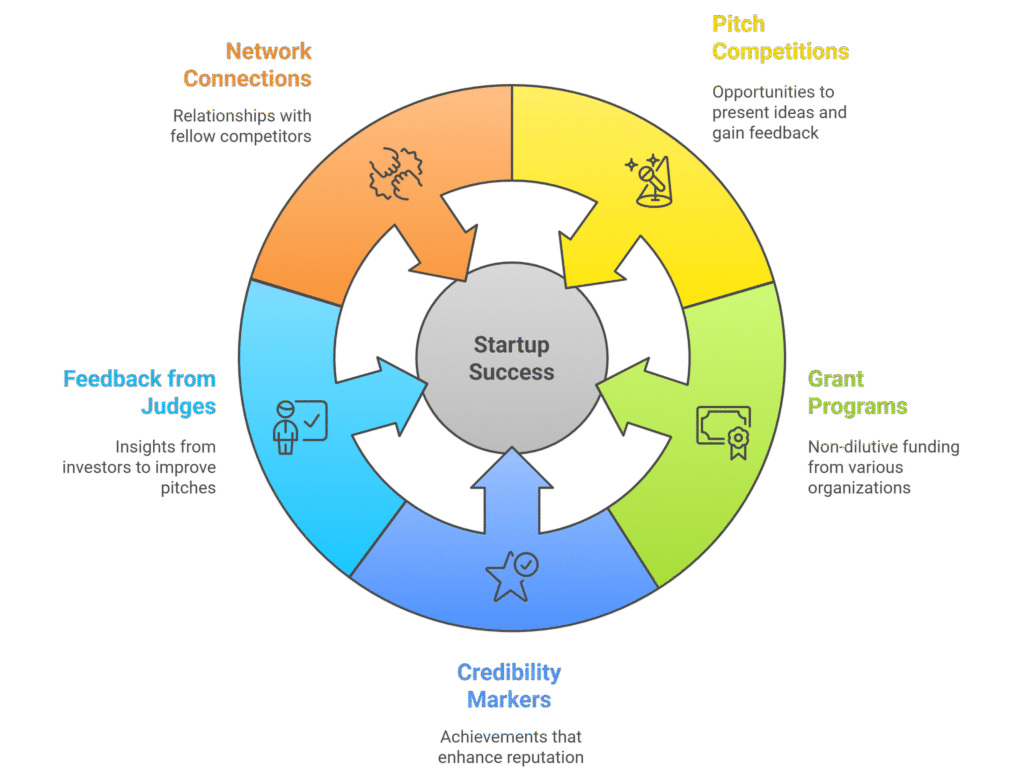
Pitch competitions provide stage time, feedback, and often capital with no need for connections.
Events like SXSW Pitch, TechCrunch Disrupt Battlefield, and industry-specific competitions draw investors in as judges and attendees. Wins or even finals create credibility markers you will use in future conversations.
Non-dilutive capital is offered in the form of grant programs from organizations such as the National Science Foundation SBIR/STTR, state-level economic development agencies, and corporate innovation programs. These awards signal third-party validation to future investors.
The Underrated Value of Competition Participation
Competitions, even if not won, also push and force you to perfect your pitch under stress.
This feedback from the judges-many of whom are active investors-picks up weaknesses in your narrative before they actually cut you out of a funding opportunity. Furthermore, many of your fellow competitors will become valuable network connections who understand the challenges you’re dealing with.
Build Relationships Long Before You Need Money
The most successful founders start investor conversations 6-9 months before they need the capital.
Send monthly or quarterly updates to investors you’ve met at events, through cold outreach, or via platform introductions. These updates should contain metrics, learnings, and tactical asks for advice, not money. The relationship you build through touchpoints puts you in a position of being a thoughtful founder worth backing when you do raise.
Investors who have followed you for several months as part of your journey feel invested in your success. By the time you actually launch your round, they have already made a decision as to whether they will participate; you are merely confirming the timing.
This patient approach does take discipline but reaps much higher conversion rates versus transactional fundraising. Much like tech trends in AI adoption, the relationship-building process in fundraising follows a gradual trust curve before reaching inflection.
FOMO: Building It Through Strategic Momentum
The investor moves quickly when they believe that a strong opportunity might pass them by.
Once you have one investor genuinely interested in your deal, you can create structured urgency around your round. You can name a specific closing date in 3-4 weeks and also mention that you will advance conversations with multiple parties.
The Rolling Close Strategy
Close tranches instead of waiting till you are able to close your entire target amount all at once.
This method demonstrates progress to later stage investors and puts pressure on making decisions. An investor, when seeing $200K already committed from others, will have much more urgency to act quickly for allocation.
Be transparent about your timeline and existing commitments without being manipulative. Investors respect founders that run efficient processes, and they understand that capital raising requires orchestration.
Perfect your financial projections and data room
Professional preparation makes up for the lack of personal relationships.
Investors who don’t know you will scrutinize your materials more than any others. Your financial model should reflect an understanding of unit economics, with realistic growth assumptions considering market dynamics.
Build a data room ahead of when you need it, with incorporation documents, cap table, customer contracts, product road map, competitive analysis, and any IP documentation. When the investor asks for materials, immediate delivery signals competence and readiness.
Common Data Room Mistakes That Kill Deals
Missing documents or disorganized materials will raise doubts over your operational capabilities.
Use DocSend or Notion to build professional, trackable data rooms that showcase what investors view and for how long. This intelligence helps you follow up strategically on the sections that generated the most interest.
Never share a link to your virtual data room before a rapport is established through preliminary discussions. The data room supports due diligence when there is mutual interest; it does not replace the building of a relationship.
Understand the Psychology of First Time Investors
Investors supporting you with no prior connections require extra confidence signals.
Then, address their unspoken concerns directly in your narrative: Why is this an inevitable team to build this? What unique insight do you have that others do not? How have you de-risked the most dangerous assumptions?
Social proof from non-investors counts for a lot. Advisors with names they’ve heard of, customers who will testify, or even media coverage from brands they respect-lowers risk for investors who can’t take your word for it.
Think about your pitch from the perspective of the investor: he’s explaining this investment to his partners or LPs. Give them a compelling story that makes them look smart for backing an unknown founder.
Use Your Company Story as Your Network
A good origin story instantly connects with investors you’ve never met.

Investors fund founders with authentic reasons for building their specific company in their specific market. Maybe it’s personal experience of the problem, deep domain expertise, or a unique insight that sparked the idea, but whatever form this narrative takes, it creates some sort of emotional resonance that substitutes for personal familiarity.
Practice articulating why you are uniquely positioned to win. This is not a credentials conversation; rather, it’s one about obsessive understanding of your customer’s pain and inevitability of your solution. If this conviction is conveyed authentically, trust builds rapidly.
This is a strategy that applies across industries, be it home improvement and real estate ventures or biotech startups; the human element of your story transcends sector.
Leveraging Strategic Advisors and Micro-Influencers
Formal advisor relationships lend credibility and sometimes warm introductions.
Recruit 2-3 relevant expert believers in your vision and formalize advisory relationships with small equity grants (0.25-0.5% with vesting). These advisors can make strategic introductions when appropriate, and their names on your cap table signal validation to investors.
Micro-influencers within your industry-people with 5,000-25,000 engaged followers on LinkedIn or Twitter-can help spread your story to relevant audiences, including investors. Most usually just want someone to talk to them and will organically promote your company if you engage them authentically with their content.
How to Approach Potential Advisors The Right Way
Never lead with the ask for introductions or investment connections.
Instead, ask for detailed advice on an actual problem you are trying to solve. Show you’ve done your homework on their background and explain why their insight is valuable. Most experienced operators love helping thoughtful founders and a relationship emerges organically from that.
Outsider Status: The Advantage in Disadvantage
Founders raising seed capital without connections often bring perspectives that well-connected founders don’t.
You’re not bound by the groupthink or received wisdom that circulates through established networks. This outsider perspective often yields contrarian insights that fuel category-defining companies. Frame your lack of connections as an advantage, in terms of intellectual independence.
Investors increasingly realize that breakthrough companies can come from anywhere. The most successful consumer apps were not created by Stanford CS graduates with Sand Hill Road connections but came from founders who knew too well the underserved markets overlooked by coastal VCs.
Your geographic location, industry background, or unconventional path can be your strengths if framed correctly. Investors want differentiated deal flow, and you are just that.
Focus on Fundamentals Over Fundraising Theater
Very rarely does time spent networking at industry events provide better returns than time spent building product and acquiring customers.
Investors respect founders who put execution above fundraising performance art. When in doubt about what to do, this week, whether to go to a conference or ship a feature your customers have asked for, ship the feature. The resulting growth is your best pitch.
That philosophy adheres to the principles of green technology and lifestyles regarding sustainable growth over artificial inflation-build real value first and capital will follow.
When Fundraising Should Take Center Stage
Focus fundraising into 4-6 week sprints rather than a constant background effort.
During these sprints, consider the raising of capital as your chief job: take meetings with 15-20 investors a week, religiously follow up, and drive toward closes. Between sprints, return to building your business with your full attention.
This approach prevents fundraising from consuming your startup while ensuring that you bring intensity to the process when timing matters.
Navigate Rejection Without Personal Relationships to Fall Back On
Fundraising rejection can feel even more personal when you do not have pre-existing relationships with investors.
Remember that most investor passes reflect portfolio construction, timing, or thesis fit rather than your company’s quality. A “no” from 50 investors means nothing if investor 51 closes your round. The successful founders who raised seed capital without connections all heard far more rejections than acceptances.
Build systematic resilience by tracking your conversion funnel, much like you would with customer acquisition. If you’re converting 5% of cold outreach to meetings and 10% of meetings to second conversations, then you know exactly how much outreach you need to hit your target.
Catalytic First Checks That Unlock Larger Commitments
Certain investors are good first checks even at small amounts since it unlocks access to others.
Strong social proof on AngelList from angel investors, founders of successful companies angel investing, or partners at respected micro-VCs provides validation that makes subsequent investors comfortable. A $25K check from the right person matters more than $100K from an unknown source.
Research which of the angels in your space are actually active in introductions to institutional investors. These individuals often see their angel investing as a form of deal sourcing for their later-stage funds or networks and thus are valuable well beyond their capital contribution.
Turning Small Checks Into Momentum
Once you have secured a few recognized names, use their commitment to create urgency with target investors.
“We’ve had strong interest from [respected angel] and [notable founder], and we’re closing this round in two weeks” creates legitimate time pressure. Most investors prefer to follow proven decision-makers rather than lead, so strategic first checks accelerate your entire process.
This approach reflects the wider trends in the travel and tourism industry, where early adopters validate new destinations before mainstream travelers commit.
The Advantage of Fundraising from Afar
For founders raising seed capital without connections, geographic constraints have disappeared.
You can pitch investors in San Francisco from Berlin; access London VCs from Austin, or connect with Singapore-based angels from Lagos. This global pool means you’re optimizing for best-fit investors rather than settling for local capital that knows your co-founder’s cousin.
Remote fundraising calls for superb video presence and crisp, confident communication. Invest in good audio equipment and lighting for video calls: Technical polish is the signal of professionalism when in-person charisma’s not an option.
Track Everything and Iterate Based on Data
Approach fundraising as if it were a problem of conversion optimization you need to work out for the eventual acquisition of customers.
Create a detailed tracking of every single investor contact: outreach date, response rate, meeting conversion, objections raised, outcome. This data will tell you their pattern, therefore helping iterate on it. Does the investor pass on valuation? Market size? Team completeness?
Successful founders adjust the pitch based on consistent feedback patterns. When five investors are worried about competitive differentiation, that section needs to be strengthened within your narrative, not hope the sixth may not catch the gap in.
Build Confidence Through Preparation and Persistence
The psychological challenge is raising seed capital without connections, and it requires inner strength.
Every successful founder who bootstrapped their investor network experienced the same doubts that you’re feeling. The difference between those who succeeded, and those who quit often came down to persistence through uncomfortable uncertainty.
Preparation begets confidence. Once you have practised your pitch 100 times, researched each investor to a great extent, and can answer any question about your market, you project competence that goes way beyond personal connections. This is in essence similar to what it takes to have any kind of transformation in health and fitness: small efforts put in consistently result in big changes.
The Role of Media Coverage in Fundraising
Strategic press coverage creates credibility that substitutes for investor relationships.
Features in industry publications, ‘startups to watch’ lists, or meaningful commentary about relevant trends all speak to you being a serious founder. Investors find companies through the media they consume, and positive coverage provides third-party validation that warms cold outreach.
That’s a challenge because it means earning coverage without any existing momentum—a classic chicken-and-egg kind of problem. Instead of reaching out to pitch your company, focus on being a genuine contributor of valuable insights to the journalists who cover your beat. If you build good relationships with relevant reporters, they’ll naturally cover your milestones when those are truly newsworthy.
Understanding the Current Market Environment
The venture capital fundraising climate in 2026 rewards profitable growth over growth-at-all-costs.
Investors who got burned in previous correction cycles now put unit economics, capital efficiency, and realistic paths to profitability front and center. This shift actually advantages founders raising seed capital without connections because the criteria are more objective and less dependent on social proof.
Show you understand this environment by building conservative financial models, highlighting sustainable growth metrics, and explaining how you’ll get to cash flow positive before requiring more capital. This narrative is comforting to the investor as you won’t constantly be on the road for round after round just to survive.
Your Competitive Advantage in 2026
Technology has removed most legitimate barriers for the raising of seed capital without connections.
The only remaining barrier is psychological-your belief that it’s possible and your willingness to execute the strategies that make it happen. It is easy to get overwhelmed by this, but the reality is that thousands of founders have had success in raising capital from complete strangers in the past year alone, and they possessed no advantages you lack.
The playbook exists. The platforms are accessible. The investors are avidly seeking deals outside their networks. Your execution determines your outcome far more than your LinkedIn connections.
Recent pop culture discussions around self-made success celebrate entrepreneurs who built from nothing—and you’re writing the next chapter of that narrative.
Take Your Next Step
Raising seed capital without connections demands a different playbook, but it is absolutely achievable with the right strategy and strong, relentless execution.
More important than anything else you could do today is building the bedrock that can make investors want to back you: demonstrable traction, a compelling narrative, and professional materials that signal competence. Everything else flows from that bedrock.
If you’re ready to amplify your story to the investors, customers, and partners that matter most, Press N’ Release Agency helps founders develop credibility through strategic content and media placement. Our packages cater specifically to the emerging company in search of visibility that turns cold outreach into warm conversations.
At the Press N’ Release Agency, learn how our strategic communications services can expedite your fundraising timeline and position your company for the capital you deserve, no matter who you know.